

How we enrich conversational agents with structured fraud intelligence and teach them to reason like seasoned analysts - moving beyond pattern-matching to narrative understanding.
Fraudsters are getting better. Not incrementally - structurally. Romance scams now run for months before the first ask. Investment schemes cite real market events. Tech support fraud uses AI-generated voice to sound like your bank. And AI has broken the old tradeoff between precision and scale - adversaries now operate with quality at volume. Every time a detection system learns a pattern, the best scammers mutate around it. The stories are engineered to land in the gray zone where automated decisions break down.
Every seasoned fraud analyst knows that gray zone - when the story almost checks out but something doesn’t sit right. Analysts often call it instinct, but it’s not a gut feeling - it’s learned experience compressed into rapid judgment, built over thousands of cases. That’s what we’re teaching our agents to develop. And it has to evolve at least as fast as the adversary.
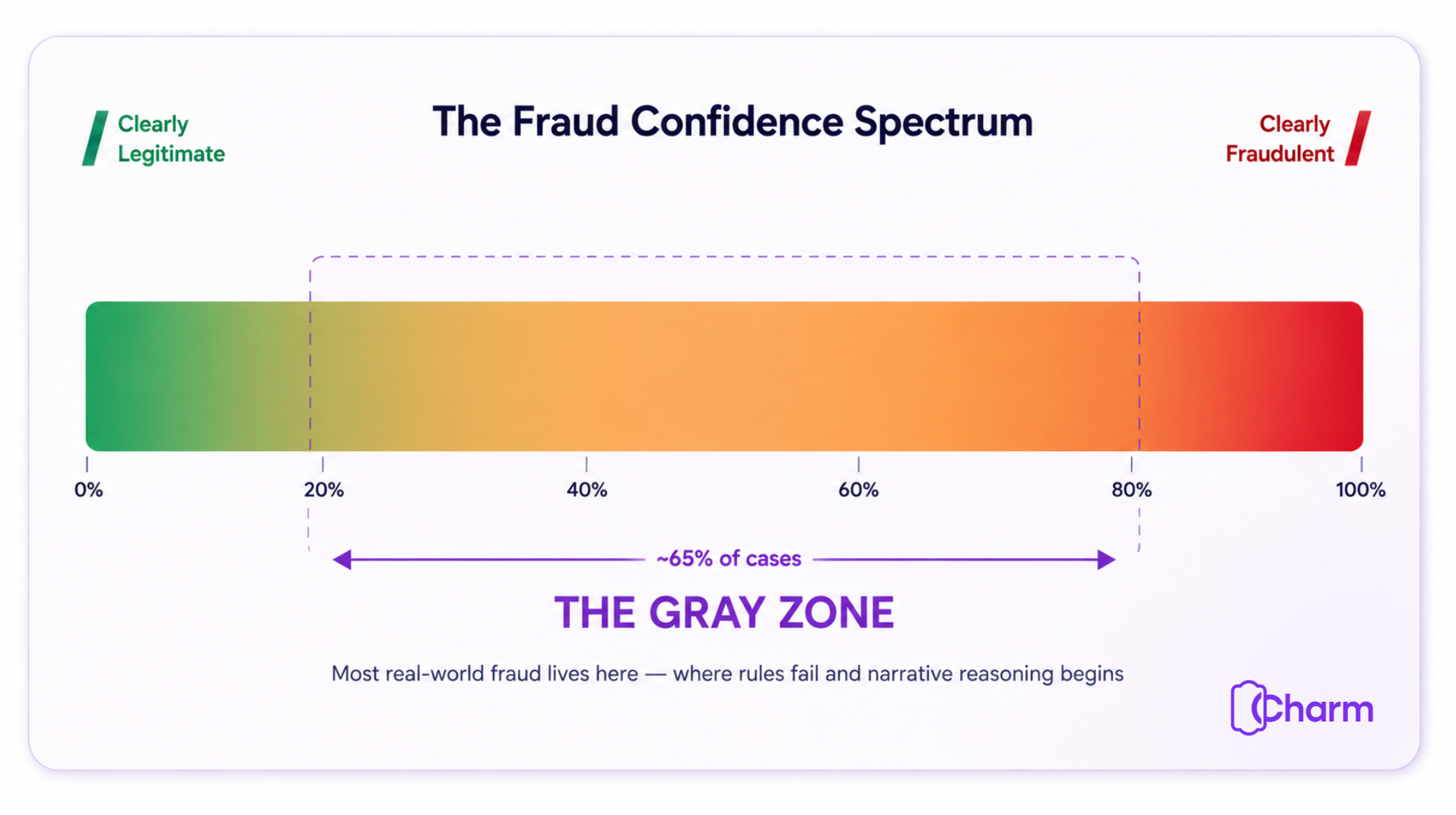
The Gray Zone
The technical challenge isn’t catching obvious fraud. It’s the mid-confidence range where the story could go either way. A romance scam victim groomed for weeks genuinely believes they’re helping a partner. An account takeover victim thinks they’re responding to a legitimate security alert. The stories are ambiguous by design. In the gray zone, a signal usually did fire - the model just couldn’t resolve what the signal meant. ‘Caught’ and ‘missed’ stop being the right axes; the question is whether the system understood the story and the intent behind it.
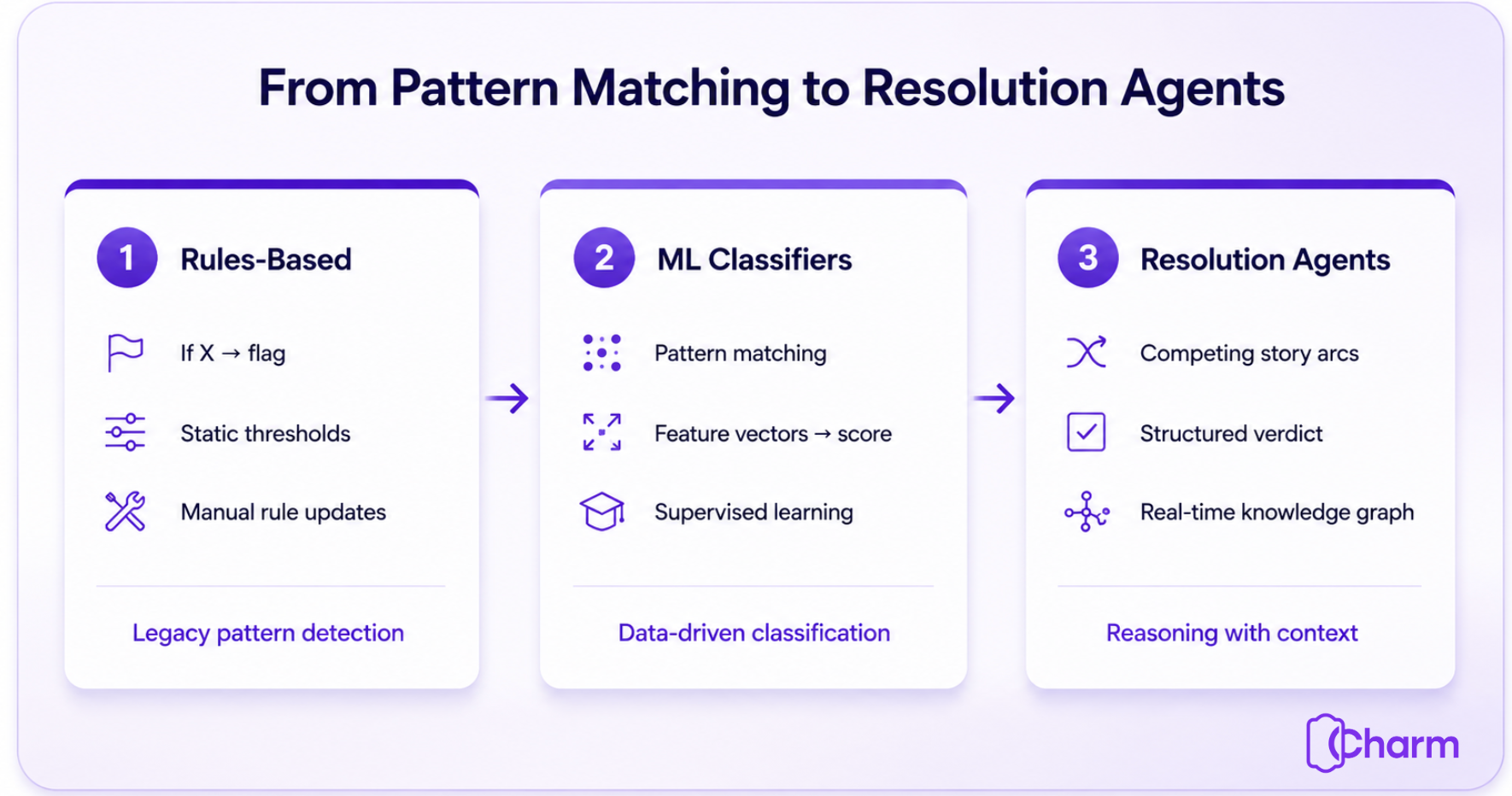
Traditional classifiers flatten a rich narrative into a feature vector and spit out a number. But fraud confidence isn’t a point estimate - it’s a moving target that shifts with every new signal. Catching stories requires something that understands narrative, not just thresholds.
Every Story Has Two Versions
Every customer interaction can be read two ways. An elderly customer buying $800 in Apple gift cards could be getting holiday presents for their grandchildren - or paying a fake tech support agent who claims their computer is locked.
That’s where our agents kick in. Instead of a single point-in-time score, we learn to understand the actual narrative.
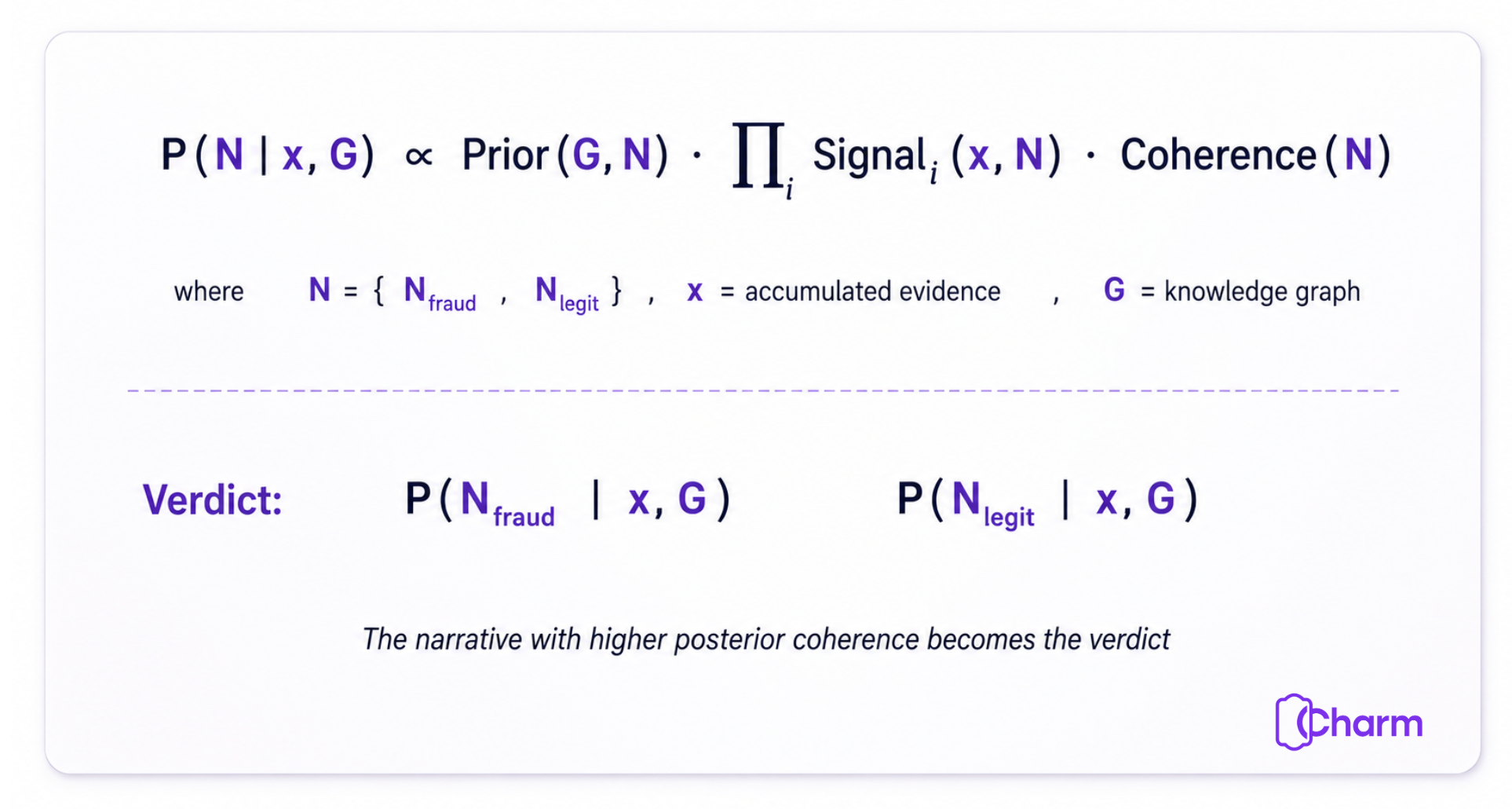
And we do it not by asking “is this fraud?”, but by building competing narrative arcs. We ask “what’s the best version?” of both the good and the bad storylines. The agent constructs two narrative arcs in parallel - one where the customer’s behavior is entirely legitimate, and one where the same facts map onto a known fraud archetype.
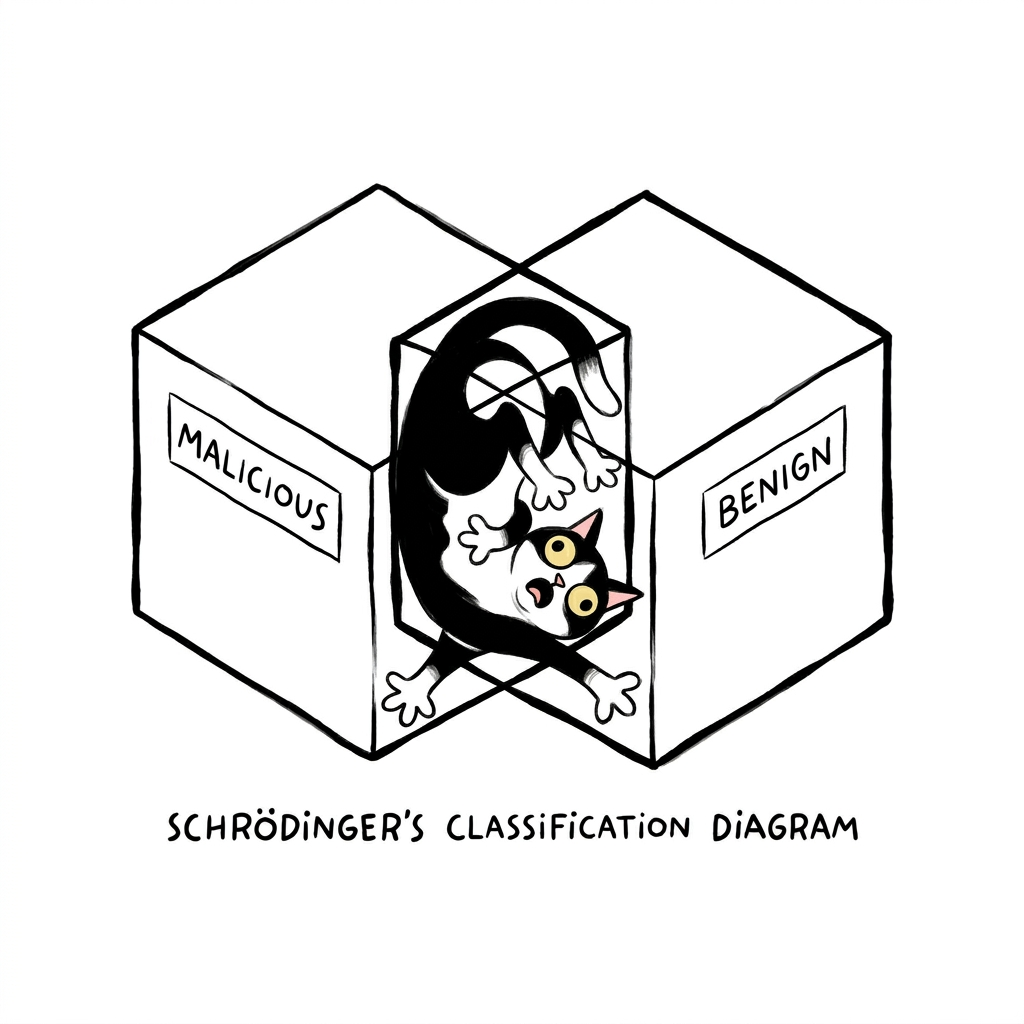
Neither interpretation is discarded. The agent actively constructs the strongest possible version of each narrative, then measures which one holds up under accumulating evidence. A fraud-only lens finds fraud everywhere. We surface cases where the bad story genuinely outcompetes the good one - not just where it looks vaguely suspicious.
Learning at the Speed of Fraud
Static models decay. Static knowledge decays faster. Fraud tactics shift constantly. A system that updates quarterly is already behind.
And so our approach starts with a simple question: what does fraud look like right now?
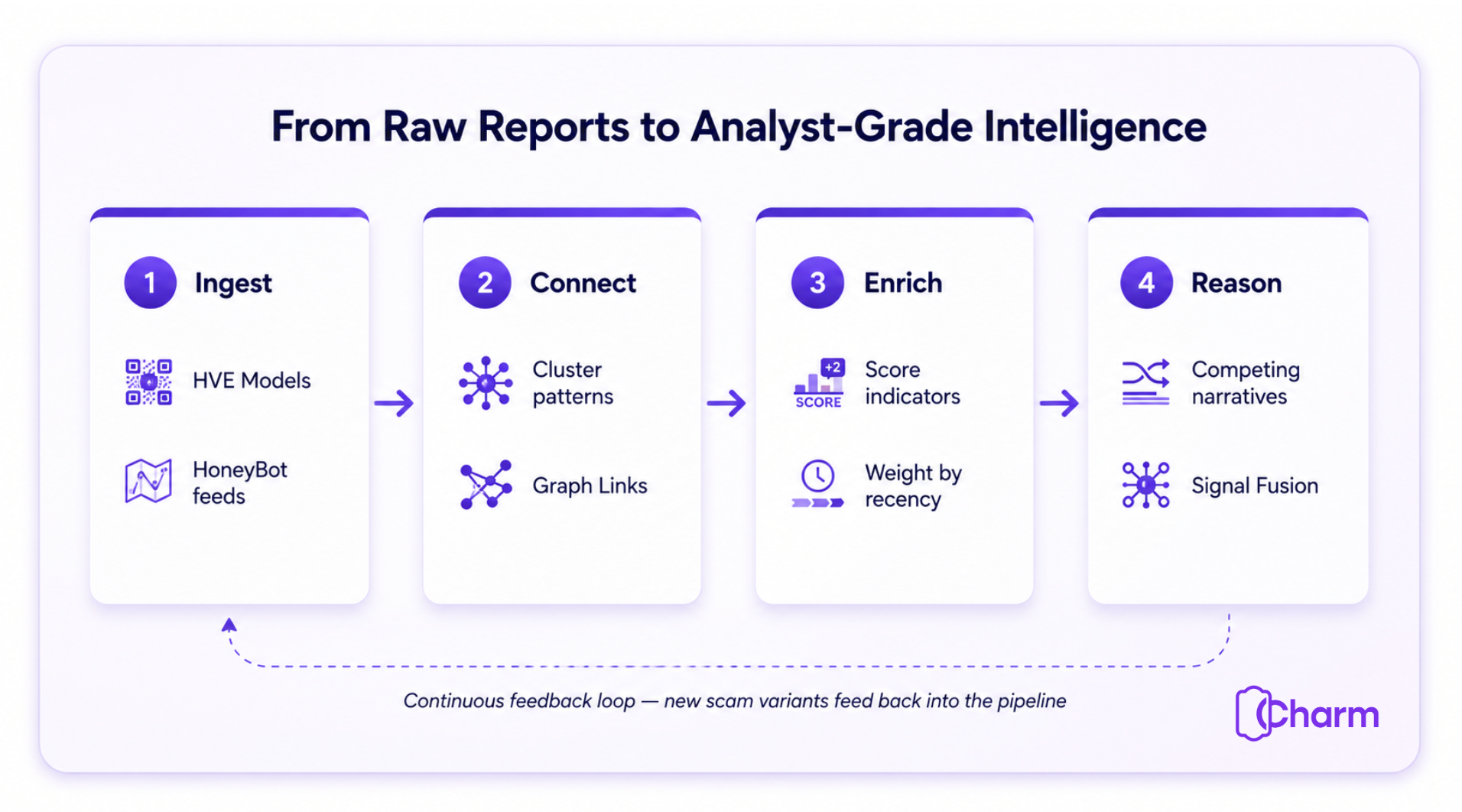
We continuously harvest scam reports and threat intelligence feeds, and supplement them with HoneyBots - autonomous AI agents we send directly into live scam interactions to extract structured intelligence on attacker infrastructure, workflows, and exploit techniques.
All of it is combined with our HVE (Human Vulnerabilities & Exploits) models - the human-side analog to CVE, cataloguing the psychological vulnerabilities and manipulation techniques behind the 80%+ of fraud that exploits people rather than software - and wired into a knowledge graph the agents query in real time. The graph is what holds the connective tissue:
- Phone numbers tied to known scam rings.
- Wallet addresses that surface across unrelated complaints.
- Narrative templates that keep showing up in victim reports.
This layer is alive - it absorbs new signals, decays stale ones, and makes sure a six-month-old indicator doesn’t carry the same weight as one confirmed last week.
How It All Comes Together
When our agents encounter a potential fraud case, they start gathering evidence for both the legitimate and the fraudulent narrative. Each piece of evidence is refined by the graph - not every piece of evidence is equal. The graph is what assigns the weight for each signal.
Our signals mainly map to three groups - behavioral (urgency patterns, escalation timing, and our HVE models), relational (similar patterns and entities), and linguistic (scripted phrases, emotional manipulation templates). Each group contributes different evidence with different reliability profiles.
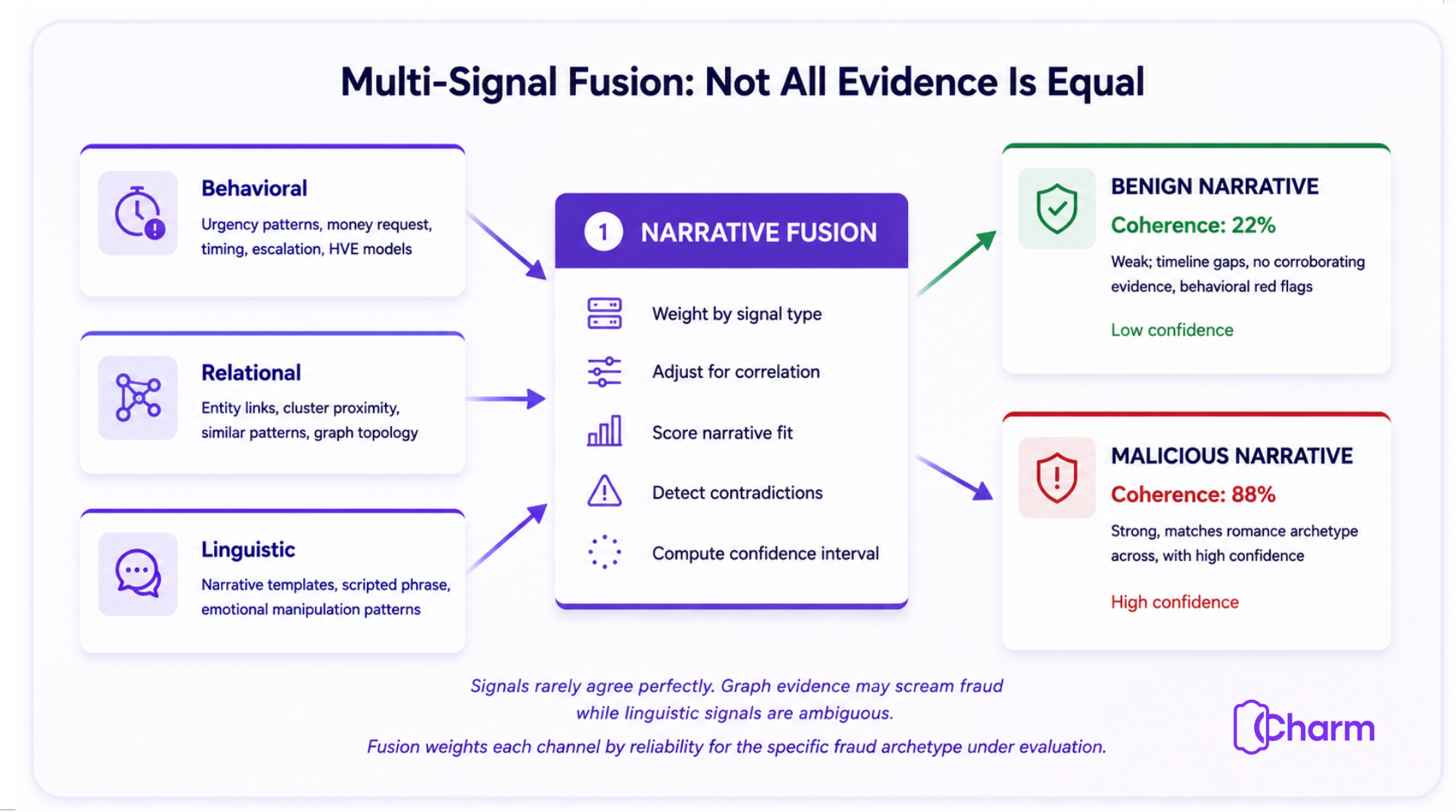
These channels rarely agree. The knowledge graph might scream fraud while the language still sounds normal. The fusion layer knows this - it weights each channel by how reliable it’s been for the specific type of fraud under evaluation. Graph proximity is a strong signal for scam clusters; linguistic patterns matter more for novel social-engineering scripts. The output isn’t a single score. It’s a structured verdict: which story is more coherent, how confident we are, and what single piece of evidence would flip the answer.
If a phone number has already been linked to three prior reports, the malicious story starts with a head start before the conversation even begins. But priors don’t determine outcomes. The agent keeps listening. The story reveals itself - which, in the end, is the only thing that beats a fraudster who’s also learning.
© 2026 Charm Security.